
Refusing a breathalyzer can feel like a way to avoid an impaired driving charge, but in Canada it is a separate criminal offence with penalties that match, and sometimes exceed, those for driving over the legal limit. Many drivers only learn this after the roadside stop, when they are already facing a criminal charge and an immediate licence suspension.
This guide explains when police in Ontario can demand a breath sample, what counts as refusing a breathalyzer, the provincial and Criminal Code penalties, and how these cases are defended. Kisel Law represents drivers facing impaired and over 80 charges in Toronto and across the GTA. This article provides general legal information and is not legal advice for a specific case.
When Can Police Demand a Breath Sample in Ontario?
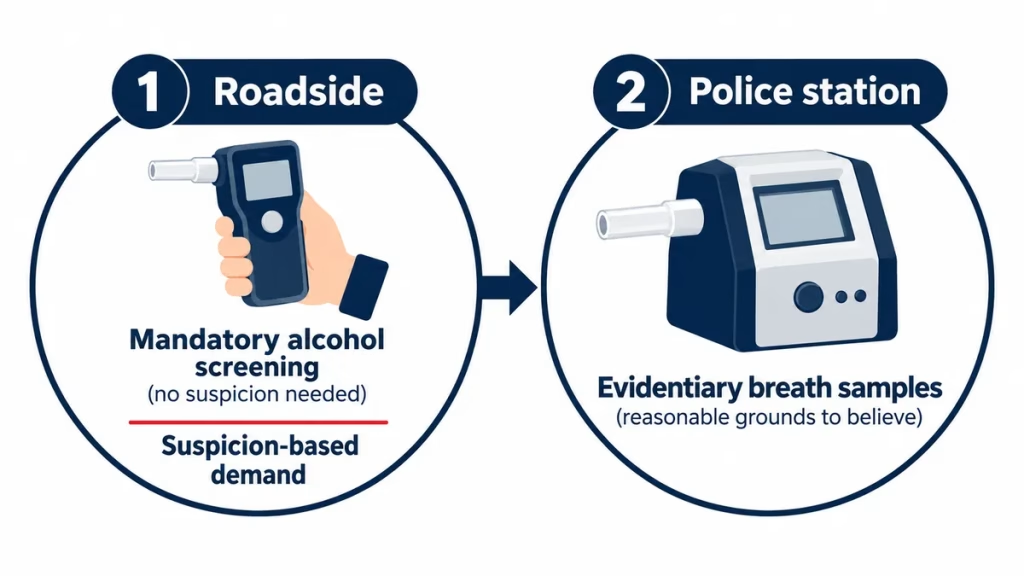
The demand is the starting point of every refusal case. Under section 320.27 of the Criminal Code, police can make two kinds of roadside demands.
- Suspicion-based demands. If an officer has reasonable grounds to suspect a driver has alcohol in their body and has operated a vehicle within the preceding three hours, the officer can demand a breath sample into an approved screening device, or physical coordination tests.
- Mandatory alcohol screening. An officer who has an approved screening device can demand a breath sample from a driver who has been lawfully stopped, without any suspicion that the driver has been drinking.
If the roadside test is failed, or the officer otherwise has reasonable grounds to believe the driver is impaired or over the legal limit, section 320.28 allows a further demand for breath samples into an approved instrument, usually at a police station. Those are the samples used as evidence in court.
Can police demand a breathalyzer without suspicion in Canada?
Yes. Mandatory alcohol screening allows an officer with an approved screening device to demand a roadside breath sample from a driver during a lawful stop, even with no sign of drinking. Some older online sources still say police need a suspicion first, which is no longer the law for this type of demand.
The stop itself must still be lawful. How you were stopped, and what happened next, can matter later, much like the issues covered in our guide on whether police can search your car in Ontario.
Can you refuse a breathalyzer at a RIDE check?
No. A RIDE check is a lawful traffic stop, so an officer with an approved screening device can make a mandatory alcohol screening demand there. Refusing a breathalyzer at a RIDE check carries the same consequences as refusing anywhere else.
What Counts as Refusing a Breathalyzer?
Under section 320.15 of the Criminal Code, it is an offence to fail or refuse to comply with a demand, without reasonable excuse, knowing that the demand was made. That covers more than simply saying “no.”
In practice, refusing a breathalyzer can include:
- clearly refusing to provide a sample at the roadside or at the station
- pretending to blow, or blowing in a way that does not produce a suitable sample
- delaying or setting conditions that amount to a refusal
- refusing physical coordination tests under a valid demand
The Crown must prove that a lawful demand was made, that the driver knew it had been made, and that the driver failed or refused to comply without a reasonable excuse. Each of those elements can be contested depending on the evidence.
Is refusing a breathalyzer worse than failing in Ontario?
It is not a way to avoid a charge. Ontario applies the same immediate roadside penalties to drivers who refuse as to drivers who blow over the limit, and the Criminal Code treats refusal as a separate offence with the same maximum penalties as impaired driving.
The minimum fine for a first refusal conviction is $2,000, which is higher than the $1,000 general minimum that applies to many first impaired driving convictions. Refusing a breathalyzer also removes the possibility of challenging a breath reading, because there is no reading to challenge.
Ontario Roadside Penalties for Refusing a Breathalyzer
The provincial consequences start immediately, before any court date. According to Ontario’s impaired driving penalties, a driver who fails or refuses to comply with a demand for alcohol or drug testing faces:
| Occurrence | Roadside penalties |
|---|---|
| First time | 90-day licence suspension, 7-day vehicle impoundment, $550 penalty, 8-hour education course |
| Second time | 90-day licence suspension, 7-day vehicle impoundment, $550 penalty, 16-hour treatment program |
| Third time | 90-day licence suspension, 7-day vehicle impoundment, $550 penalty, 16-hour treatment program, ignition interlock for six months |
These administrative penalties apply immediately and are separate from the criminal charge, which continues through the courts on its own timeline.
Criminal Penalties for Refusing a Breathalyzer
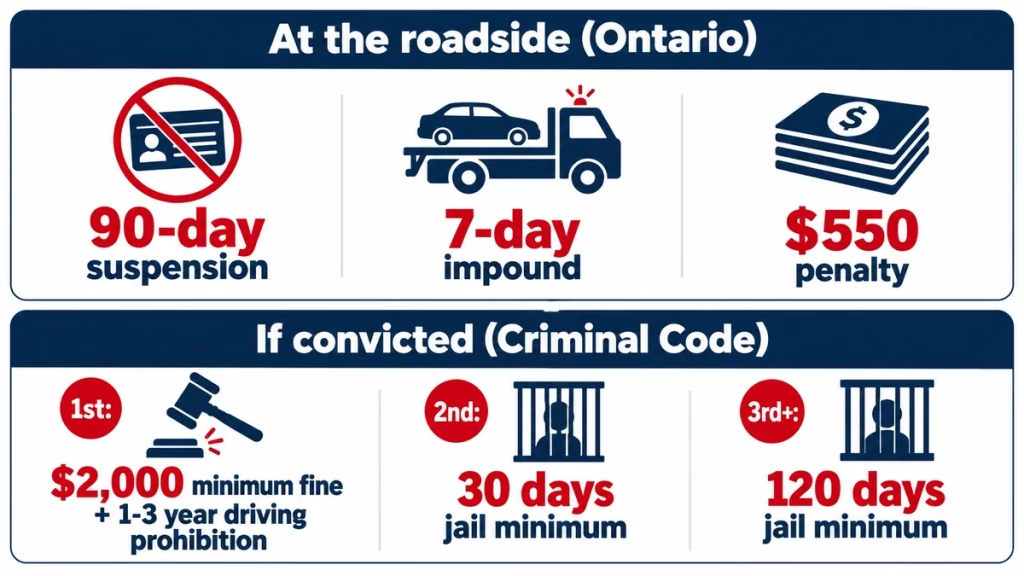
The criminal side is where the long-term consequences sit. A conviction for refusing a breathalyzer creates a criminal record, and the Criminal Code sets these penalties:
- First offence: a minimum fine of $2,000.
- Second offence: a minimum of 30 days in jail.
- Third or later offence: a minimum of 120 days in jail.
- Maximum: up to 10 years if the Crown proceeds by indictment, or up to two years less a day and a $5,000 fine on summary conviction.
A conviction also brings a mandatory Criminal Code driving prohibition of one to three years for a first offence, two to 10 years for a second, and at least three years for any later offence. Our article on the Criminal Code driving prohibition explains how these orders work.
What happens to your licence after a refusal conviction in Ontario?
You lose the right to drive for at least the length of the Criminal Code prohibition, which is one year for a first offence. Ontario also imposes its own licence consequences after criminal impaired driving convictions, including suspensions, mandatory education or treatment programs and ignition interlock conditions.
Because the exact provincial consequences depend on the conviction and your driving history, ask a lawyer to confirm how they apply after refusing a breathalyzer in your situation.
What Happens After a Refusal Charge?
After a charge for refusing a breathalyzer, the driver is usually released with paperwork that sets a first court date, along with the roadside suspension and impound notices. The criminal case and the provincial penalties then run on separate tracks.
- Roadside penalties begin. The 90-day suspension and 7-day impoundment start right away.
- First court appearance. The case is usually adjourned so the defence can receive and review disclosure.
- Disclosure review. Police notes, video and the demand wording are examined closely.
- Resolution discussions or trial. Decisions in a case about refusing a breathalyzer are best made once the evidence has been reviewed.
Keep every document you receive and write down your own recollection of the stop while it is still fresh, for your lawyer only.
How Refusal Cases Are Defended
Every refusal case turns on its own facts, and there is no standard defence that works in all of them. A lawyer will usually start by reviewing the police notes, any video from the cruiser or station, and the timeline. Our guide to criminal disclosure in Ontario explains how that evidence is obtained.
Common questions in a defence review include:
- Was the demand valid? For a suspicion-based demand, did the officer actually have reasonable grounds to suspect? For mandatory screening, did the officer have an approved device?
- Was the demand clear? Did the driver understand what was being asked and the consequences of refusing?
- Was there a reasonable excuse? A genuine medical condition that prevented a proper sample is one example courts have considered, but it depends heavily on the evidence.
- Were Charter rights respected? Issues with detention, the right to counsel or delays can lead to Charter applications to exclude evidence.
None of these issues guarantees a particular result. They are the starting points a lawyer uses to assess the strength of the Crown’s case.
Can you change your mind after refusing a breathalyzer?
Sometimes, but timing is critical. If a driver quickly reconsiders and offers to provide a sample while the process is still ongoing, that can be relevant to whether a refusal occurred. Once the officer has closed the process and laid the charge, a later offer is far less likely to help.
Mistakes to Avoid After Refusing a Breathalyzer
- Assuming a refusal is “safer” than blowing. It is a separate criminal offence with a higher minimum first-offence fine.
- Driving during the 90-day suspension. It creates further legal problems.
- Explaining the refusal to police after the charge without first speaking to a lawyer.
- Pleading guilty early without reviewing disclosure for problems with the demand or Charter issues.
- Ignoring employment consequences, especially if your job involves driving.
Talk to Kisel Law About Refusing a Breathalyzer
A charge for refusing a breathalyzer carries both immediate licence consequences and a possible criminal record. The best approach depends on how the demand was made, what the police recorded and your driving history.
Kisel Law defends drivers in Toronto and across the GTA. Learn more about our DUI defence services, or contact Kisel Law to book a confidential consultation. Bring your release papers, the roadside suspension and impound notices, and any documents you received from police.