

Crown Screening Form Ontario is a document that can play an important role after criminal charges are laid and disclosure is prepared. For many people, it is one of the first written signs of how the Crown prosecutor views the case.
The form may look simple, but it can contain important information about the charges, the Crown’s position, possible resolution options, and what the prosecution may seek if the case moves forward.
If you have received disclosure and noticed a Crown screening form or charge screening form, it is worth taking the document seriously. It does not decide guilt. It does not mean the Crown’s view is final. But it can help show the direction of the case and the decisions you may need to make.
This guide explains what a Crown Screening Form Ontario is, what it may include, how it connects to disclosure, diversion, plea discussions, jail or probation positions, Legal Aid, and why legal advice can be important before you respond to anything in court.
What Is a Crown Screening Form Ontario?
A Crown Screening Form Ontario is usually part of the Crown’s early review of a criminal case. After police lay charges, the Crown prosecutor reviews the file and considers how the matter should proceed.
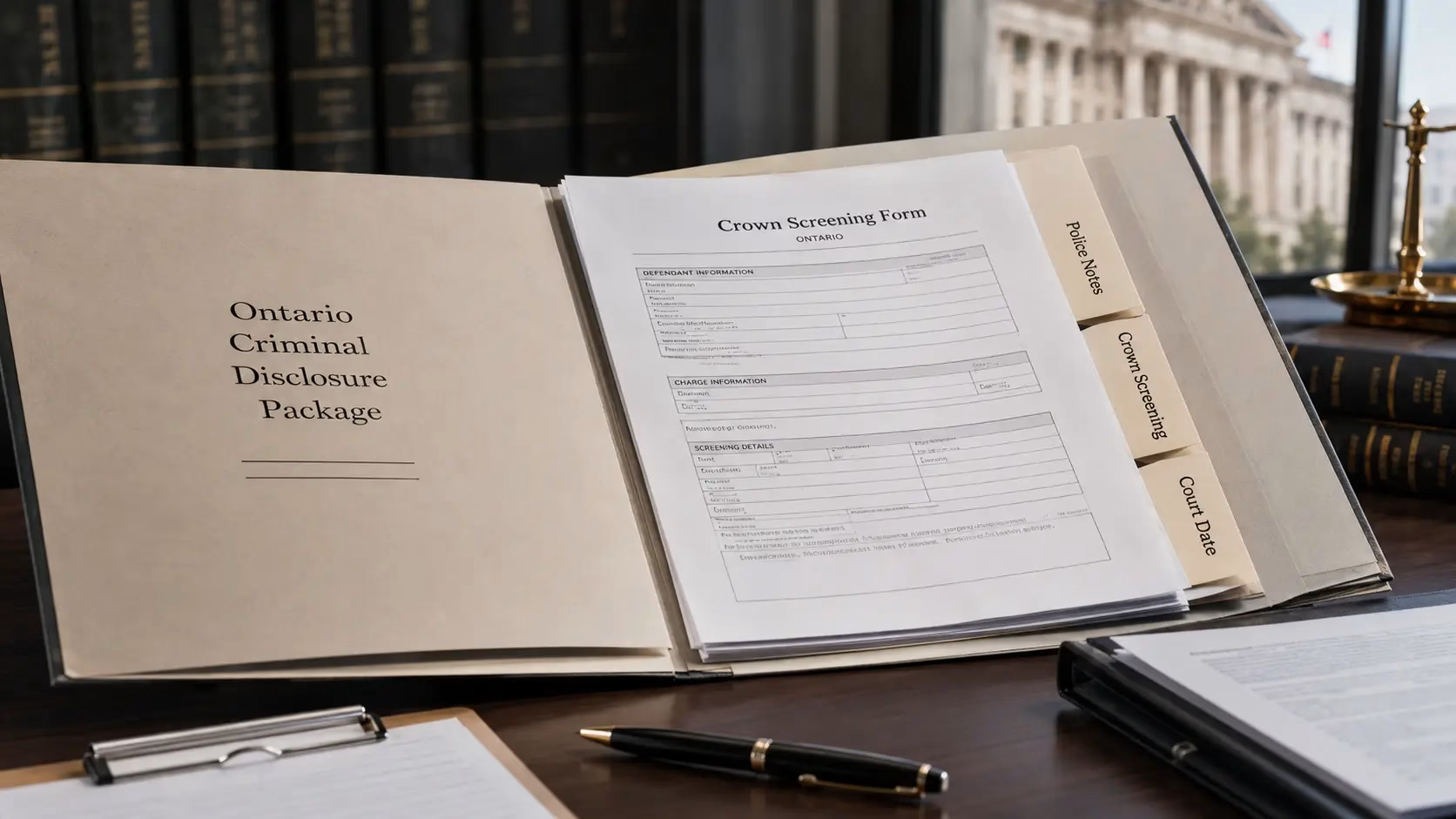
The Crown may look at the police notes, witness statements, videos, photos, reports, criminal record information, alleged victim impact, and other available evidence. The Crown then records certain screening decisions or comments on the form.
Depending on the case, the form may include the Crown’s view on whether the charge should proceed, whether the case is eligible for diversion, what sentence the Crown may seek, whether jail is being considered, and whether further disclosure is needed.
For someone who has never been charged before, this can be stressful. You may already be dealing with an appearance notice in Ontario, an undertaking, bail conditions, or a first court date. Seeing the Crown’s written position can make the situation feel more serious.
However, the form is not the end of the case. It is a starting point for understanding the Crown’s position.
Why the Crown Screening Form Matters
The Crown Screening Form Ontario matters because it can help identify what is at stake early in the process.
A person may believe that all criminal charges follow the same path. In reality, cases can move in very different directions.
Some cases may be suitable for withdrawal, diversion, a peace bond, or a non-trial resolution. Others may involve a Crown position seeking probation, a criminal record, jail, or strict conditions. More serious cases may require detailed trial preparation, Charter applications, expert evidence, or negotiations over the proper charge.
The form can provide clues about:
- Whether the Crown sees the case as minor, moderate, or serious.
- Whether the Crown is open to resolving the case without a trial.
- Whether the Crown is considering jail.
- Whether the Crown may consent to diversion.
- Whether there are disclosure issues that still need to be addressed.
- Whether the case may require a Crown pre-trial or judicial pre-trial.
If your case is still at an early stage, Kisel Law’s article on the first court appearance in Ontario explains how early court dates usually work and why disclosure matters before major decisions are made.
What Information Can Appear on a Crown Screening Form?
A Crown Screening Form Ontario may vary depending on the courthouse, the charge, and the Crown’s office. Not every form looks the same. Not every form contains the same amount of detail.
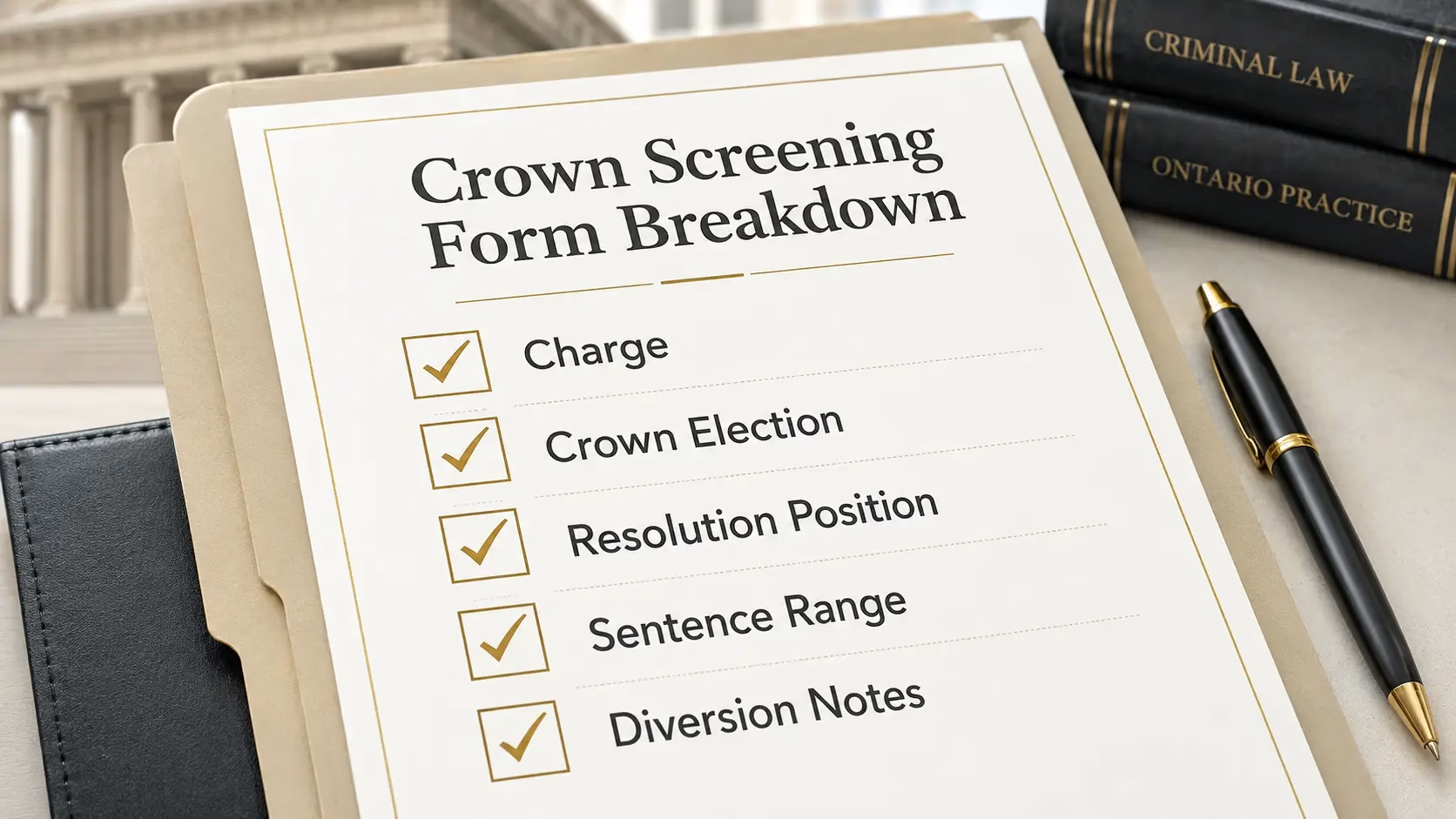
Still, many forms include information such as:
- The charges before the court.
- The accused person’s name and identifying details.
- The Crown’s initial screening position.
- The type of Crown election, where applicable.
- Whether the Crown is proceeding summarily or by indictment, if the offence allows that choice.
- The Crown’s initial sentencing position.
- Whether the Crown is seeking jail, probation, a fine, restitution, or another penalty.
- Whether diversion or alternative measures may be available.
- Whether a peace bond may be considered.
- Whether there are concerns about public safety, weapons, violence, breach allegations, or prior record.
- Whether more disclosure is outstanding.
- Whether the Crown expects the matter to require trial time.
The form may also include short notes about the strength of the case, the alleged facts, or the Crown’s concerns. These notes can be important, but they should not be read in isolation.
The Crown’s position may be based on the information available at that time. If disclosure is incomplete, if evidence changes, or if the defence raises legal issues, the position may change.
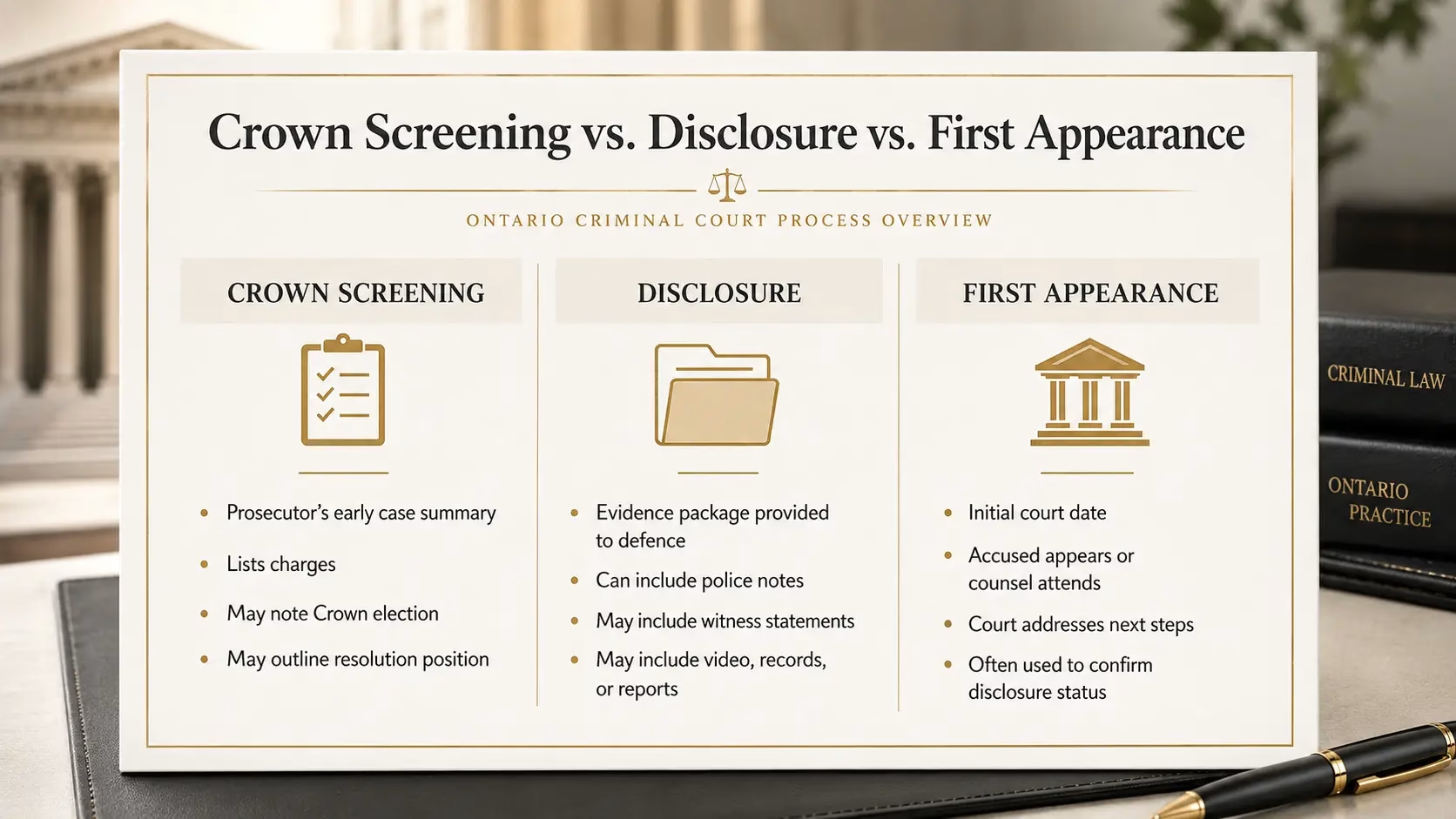
Crown Screening Form vs. Disclosure vs. First Appearance
A common source of confusion is the difference between the Crown screening form, disclosure, and a first appearance. They are connected, but they are not the same thing.
| Item | What It Means | Why It Matters |
|---|---|---|
| Crown Screening Form | The Crown’s early review and position on the case | Shows how the prosecution may approach the file |
| Disclosure | The evidence and case materials provided to the defence | Allows the accused and lawyer to assess the allegations |
| First Appearance | An early court date to organize the next steps | Confirms disclosure, representation, scheduling, and next dates |
| Judicial Pre-Trial | A meeting involving a judge, Crown, and defence | Helps narrow issues, discuss resolution, or plan trial |
The Crown Screening Form Ontario is not a substitute for disclosure. It may summarize the Crown’s position, but disclosure contains the material needed to evaluate whether that position is fair or legally supportable.
For example, a form might say the Crown is seeking probation. But the defence still needs to review the evidence carefully. Are the witness statements consistent? Is there video? Were police notes complete? Was the accused lawfully arrested? Was there a search issue? Were Charter rights respected?
Kisel Law’s guide to criminal disclosure in Ontario explains why disclosure is one of the most important parts of defending a criminal charge.
Does the Crown Screening Form Mean the Crown Has a Strong Case?
Not necessarily.
A Crown Screening Form Ontario shows the Crown’s early position. It does not prove the allegations. It does not mean the accused will be convicted. It does not mean the Crown’s position is legally correct.
The Crown may believe there is a reasonable prospect of conviction based on the information available. But the defence may identify problems that are not obvious from the form alone.
For example, there may be issues with:
- Identification evidence.
- Contradictions between witnesses.
- Missing video footage.
- Unreliable statements.
- Improper police searches.
- Unlawful detention.
- Problems with a search warrant.
- Lack of proof for an essential element of the offence.
- Gaps in financial records.
- Issues with complainant credibility or reliability.
If your case involves a search of a home, vehicle, business, phone, or computer, the screening form should be considered alongside potential search and seizure issues. Kisel Law’s search warrants page and article on police searching your phone in Canada may be useful starting points.
The Crown’s Job: Reasonable Prospect and Public Interest
Crown prosecutors in Ontario are expected to assess whether a prosecution should continue. This usually involves two broad questions.
First, is there a reasonable prospect of conviction?
Second, is prosecution in the public interest?
The first question focuses on evidence. The Crown must consider whether the available evidence could realistically support a conviction. This is not the same as proving the case beyond a reasonable doubt at trial, but it is still an important screening step.
The second question focuses on whether the case should proceed even if evidence exists. Public interest may involve the seriousness of the allegation, harm caused, safety concerns, prior record, the accused person’s circumstances, the complainant’s position, and whether alternatives may be appropriate.
This is why the Crown Screening Form Ontario can be different from one case to another. Two people charged with the same offence may see very different Crown positions because the facts, records, risks, and evidence are different.
A first-time accused facing a minor allegation may be screened differently than someone charged with repeated breaches, domestic violence, firearms offences, large-scale fraud, or serious impaired driving allegations.
What If the Crown Screening Form Mentions Diversion?
If the form mentions diversion, alternative measures, or direct accountability, that can be significant.
Diversion may allow some eligible cases to be resolved without a trial and, in some situations, without a criminal conviction. It can involve steps such as counselling, community service, restitution, apology letters, charitable donations, or other conditions.
However, diversion is not automatic.
The Crown may consider the type of offence, the facts, the accused person’s record, the complainant’s views, public safety, and whether the accused accepts responsibility in a way that fits the program.
It is also important not to rush. A person should understand what they are agreeing to before entering diversion. In some cases, what sounds like an easy resolution may have immigration, employment, professional licensing, family law, travel, or reputational consequences.
For some lower-level allegations, a peace bond in Ontario may also become part of the discussion. A peace bond is not the same as diversion, but both can arise in resolution conversations depending on the facts.
What If the Crown Screening Form Mentions Jail?
Seeing jail mentioned on a Crown Screening Form Ontario can be alarming. It does not mean jail is guaranteed. It means the Crown may be considering jail as part of its initial position.
This can happen for many reasons.
The allegation may be serious. There may be a prior record. There may be breach allegations. The Crown may allege violence, weapons, planning, financial harm, impaired driving consequences, vulnerable complainants, or repeated conduct.
Still, the Crown’s initial position can change.
A defence lawyer may challenge the evidence, negotiate with the Crown, raise mitigating circumstances, address weaknesses in the case, propose treatment or counselling, or argue for a different outcome. In some cases, the defence may recommend trial if the evidence is weak or the Crown position is unreasonable.
If the case involves release conditions, breaches, or bail concerns, Kisel Law’s pages on bail hearings and breaching court orders may be relevant.
The key point is simple: do not panic, but do not ignore it. If jail is mentioned, legal advice should be obtained as soon as possible.
How the Crown Screening Form Can Affect Plea Discussions
The Crown Screening Form Ontario often becomes a starting point for plea discussions, but it should not be treated as the final word.
A plea discussion may involve the charge, the facts, the sentence, restitution, counselling, probation terms, weapons prohibitions, driving consequences, DNA orders, no-contact terms, or other conditions.
In some cases, the defence may push back on the Crown’s facts. This matters because the facts read into court can affect sentence, criminal record consequences, immigration issues, family proceedings, employment, and reputation.
For example, a fraud case may involve disagreement over the amount of loss, planning, breach of trust, number of complainants, or whether restitution is realistic. Kisel Law’s fraud, insurance fraud, and white collar crime pages explain how complex financial allegations can require careful review before any resolution is considered.
Plea discussions should be based on evidence, legal risk, and the accused person’s goals. They should not be based only on fear, pressure, or a quick reading of the screening form.
Can the Crown Screening Form Help With Legal Aid?
A Crown Screening Form Ontario may also be relevant when applying for Legal Aid or explaining the seriousness of a case.
Legal Aid Ontario may consider the nature of the charges, the Crown’s position, the possibility of jail, and other factors when assessing eligibility and coverage. If the Crown screening form indicates that jail is being sought, that may be important information.
However, Legal Aid decisions involve more than the form alone. Financial eligibility, the type of case, the seriousness of the allegations, and other details may all matter.
If you are applying for Legal Aid, it can be helpful to have your disclosure package and Crown screening form available. You can also review general information through Legal Aid Ontario.
What Should You Do After Receiving a Crown Screening Form?
After receiving a Crown Screening Form Ontario, the most important step is to slow down and understand what it actually means.
Do not assume the case is hopeless because the Crown position sounds serious. Do not assume the case is minor because the form mentions diversion. Do not contact witnesses to “clear things up.” Do not breach conditions. Do not miss court. Do not plead guilty just to get the case over with before understanding the evidence and consequences.
A practical next step is to review the form alongside the full disclosure package.
Ask these questions:
- What charges are listed?
- What is the Crown’s initial position?
- Is jail being sought?
- Is diversion mentioned?
- Is disclosure complete?
- Are police notes, videos, photos, or witness statements missing?
- Are there Charter issues?
- Are there immigration, employment, travel, or family consequences?
- Is the Crown position realistic based on the evidence?
- Should the matter be set for a Crown pre-trial, judicial pre-trial, resolution meeting, or trial?
The answers depend on the facts. This is why the form is useful, but not enough on its own.
Mistakes to Avoid When Reading the Crown Screening Form
One of the biggest mistakes is treating the Crown Screening Form Ontario as a judge’s decision. It is not. It is the Crown’s position at a point in time.
Another mistake is focusing only on the proposed sentence and ignoring the evidence. A person may become so worried about jail, probation, or a criminal record that they forget to ask whether the Crown can prove the case.
A third mistake is assuming that diversion means there are no consequences. Diversion may be a good outcome in some cases, but it still needs to be understood carefully.
A fourth mistake is discussing the case with people connected to the allegations. If you are bound by an undertaking, release order, bail condition, or no-contact term, contacting someone may create a new criminal charge.
A fifth mistake is missing court because you believe nothing will happen at an administrative appearance. Missing court can lead to additional problems, including a warrant or new charges.
If you are unsure about your release document, review Kisel Law’s article on an undertaking in Ontario or speak with a defence lawyer before taking any step that could breach your conditions.
How the Form Fits Into the Larger Ontario Criminal Court Process
The Crown Screening Form Ontario is one part of a larger process.
In many cases, the sequence looks like this:
- Police lay the charge.
- The accused is released or held for bail.
- The accused receives a first court date.
- Disclosure is requested or provided.
- The Crown screening form is reviewed.
- The defence reviews the evidence.
- The case may move toward resolution discussions, a Crown pre-trial, a judicial pre-trial, or trial.
This process can move quickly or slowly depending on the case. Some matters resolve early. Others require months of disclosure follow-up, legal analysis, negotiation, and trial preparation.
For people in Toronto and the GTA, location can also matter. Courthouse practices, Crown assignment, scheduling, and local procedures may differ. Kisel Law represents clients across Toronto and surrounding areas, including through its pages for criminal lawyer Toronto, Brampton criminal lawyer, Mississauga criminal lawyer, Scarborough criminal lawyer, and North York criminal lawyer.
Why the Crown’s Initial Position Can Change
A Crown Screening Form Ontario is important, but it is not frozen forever.
The Crown’s view can change when new disclosure arrives, when the defence identifies weaknesses, when witnesses become unavailable, when legal issues are raised, or when negotiations narrow the dispute.
For example, the defence may point out that a key witness gave inconsistent statements. Video may show something different from the written summary. Police may have searched a phone without proper authority. A complainant may not support prosecution. A restitution issue may be resolved. Counselling or treatment may change the resolution discussion.
The Crown may also change its position after a Crown pre-trial or judicial pre-trial. Kisel Law’s article on a judicial pre-trial in Ontario explains how judicial input can sometimes help move a case forward.
This is why early defence work can matter. The sooner the issues are identified, the sooner the defence can begin shaping the path of the case.
How Kisel Law Can Help You Understand the Crown Screening Form

A Crown Screening Form Ontario can tell you a lot, but it does not tell you everything.
It may show the Crown’s initial position, but it does not explain every weakness in the evidence. It may mention jail, diversion, probation, or withdrawal, but it does not tell you what strategy is best. It may summarize the Crown’s view, but it does not replace legal advice based on the full disclosure package.
Kisel Law helps clients understand criminal charges, disclosure, Crown screening, resolution options, trial risks, Charter issues, and the practical consequences of each decision. Whether your case involves assault, domestic allegations, fraud, impaired driving, breach charges, weapons allegations, search issues, or another criminal offence, the right next step depends on the evidence and the Crown’s position.
If you have received a Crown screening form and are unsure what it means, do not make decisions based on fear or guesswork. Review the document with a defence lawyer who can explain what the Crown is saying, what may be missing, and what options may be available.
To speak with Kisel Law about your case, visit the firm’s contact page or learn more about its criminal defence practice areas. Early advice can help you understand the Crown’s position before you decide whether to negotiate, seek diversion, challenge the evidence, or prepare for trial.